Why People Make Mistakes
- Michael Matthew
- Dec 29, 2025
- 2 min read
(And why blaming them never fixes the problem)
Here’s the uncomfortable truth most safety programs avoid:
People don’t fail at work because they don’t care.They fail because the system quietly makes failure the easiest option.
If you’ve spent time on a job site, shop floor, or control room, you already know this—even if it’s rarely said out loud.
Good People. Bad Moments.
Most workers show up wanting to do a good job.They want to go home safe.They want to be competent, reliable, trusted.
Yet incidents still happen.
Not because someone woke up reckless—but because human decision-making degrades under pressure.
Stress Shrinks the Brain (Literally)
Picture this:
It’s early morning.The crew is short one person.Equipment is acting up.Production is already behind.
Stress isn’t just emotional—it’s cognitive.
Under stress, people don’t process information the same way. Attention narrows. Memory slips. The brain starts prioritizing speed over accuracy.
That’s when:
A safety check gets skipped
A warning sign fades into the background
A “quick workaround” feels reasonable
Tunnel vision isn’t a character flaw. It’s a stress response.
Hurry Changes the Rules
Now add time pressure.
The supervisor says, “Let’s just get through this part.”The permit takes longer than expected.The client is waiting.
Suddenly, the rulebook feels optional.
Not because people don’t know the procedure—but because the immediate reward (getting the job done) outweighs the abstract risk (something might go wrong).
In the moment, the shortcut feels smart.After the incident, it looks careless.
Same person.Different context.
Fatigue, Distractions, and the Night Shift Effect
Errors multiply when people are tired.
Late shifts.Overtime.Back-to-back days.
Reaction times slow. Situational awareness drops. Small interruptions—radio calls, questions, alarms—break concentration and increase the odds of missing a step.
Ever seen someone restart a task and forget where they left off?
That’s not incompetence.That’s human limitation.
Complex Systems Create Simple Mistakes
Now layer in:
Complicated procedures
Poorly designed tools
Inconsistent training
Conflicting priorities
Even highly skilled, experienced workers will eventually trip over a system that’s working against them.
When safety relies on people being perfect every time, the system is already broken.
The Real Problem Isn’t “Human Error”
Calling incidents “human error” feels tidy—but it stops the conversation too early.
It treats mistakes as causes instead of symptoms.
A better question is:
What conditions made this decision seem reasonable at the time?
That’s where learning lives.
Shift the Focus, Change the Outcome
When you stop blaming individuals and start examining:
Stress levels
Time pressure
Fatigue
Task design
Supervisory expectations
…you stop chasing people—and start fixing systems.
That’s how resilient safety programs are built.Not by demanding perfection, but by designing work that supports human performance.
Final Thought
The next time a mistake happens, ask yourself:
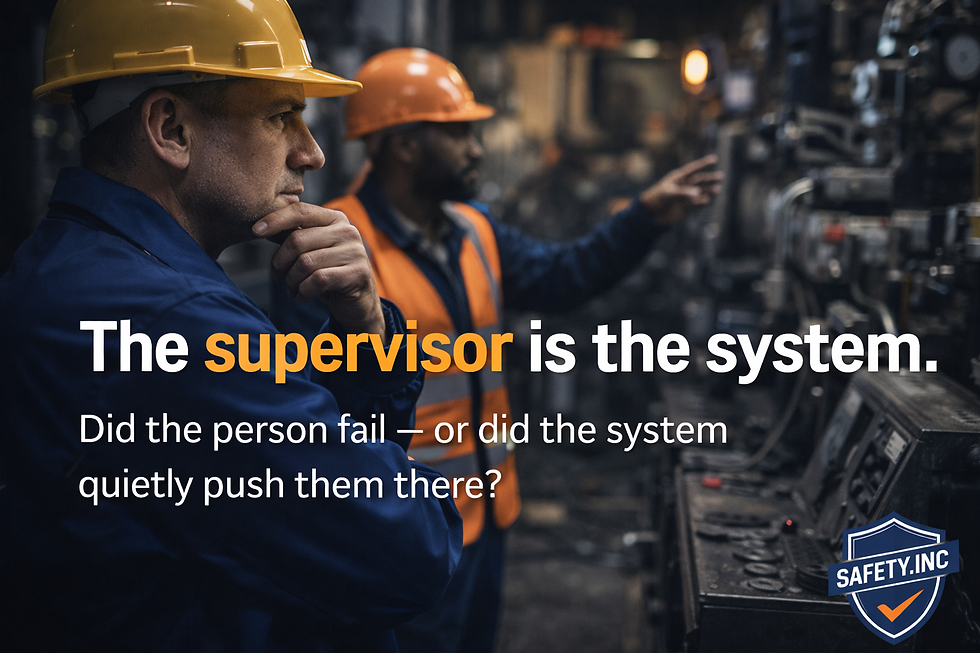
Did the person fail—or did the system quietly push them there?
That question alone can change everything.
Michael Matthew Mike@SAFETY.INC Dec 2025


Comments